INTERNATIONAL DAY OF PEOPLE WITH DISABILITIES: Salesian Missions highlights programs that focus on inclusion
Programs advance inclusivity for people with disabilities.
NEW ROCHELLE, NY (Dec. 3, 2025) Salesian Missions, the U.S. development arm of the Salesians of Don Bosco, joins humanitarian organizations and countries around the globe in honoring International Day of People with Disabilities. Since its inception in 1945, the United Nations has outlined and reiterated its commitment to calling for the creation of inclusive, accessible, and sustainable societies and communities. In 1981, the U.N. proclaimed Dec. 3 as a recognized day for the celebration of the achievements of people living with disabilities across the world.
The World Health Organization (WHO) World Report on Disability noted that nearly an estimated 1.3 billion people experience significant disability. This represents 16% of the world’s population, or one in six people. Persons with disabilities have twice the risk of developing conditions such as depression, asthma, diabetes, stroke, obesity or poor oral health.
It’s also noted that, “Health inequities arise from unfair conditions faced by persons with disabilities, including stigma, discrimination, poverty, exclusion from education and employment, and barriers faced in the health system itself.”
Father Micheal Conway, director of Salesian Missions, said, “Youth with disabilities are able to accomplish as much as their peers if given the right resources and support. In many communities around the globe, children and older adults with disabilities often lack the same opportunities. Salesians are working to level the field by providing equal access and inclusion.”
Salesian Missions is proud to highlight Salesian programs that advance inclusivity for people with disabilities on International Day of People with Disabilities 2025.
BRAZIL
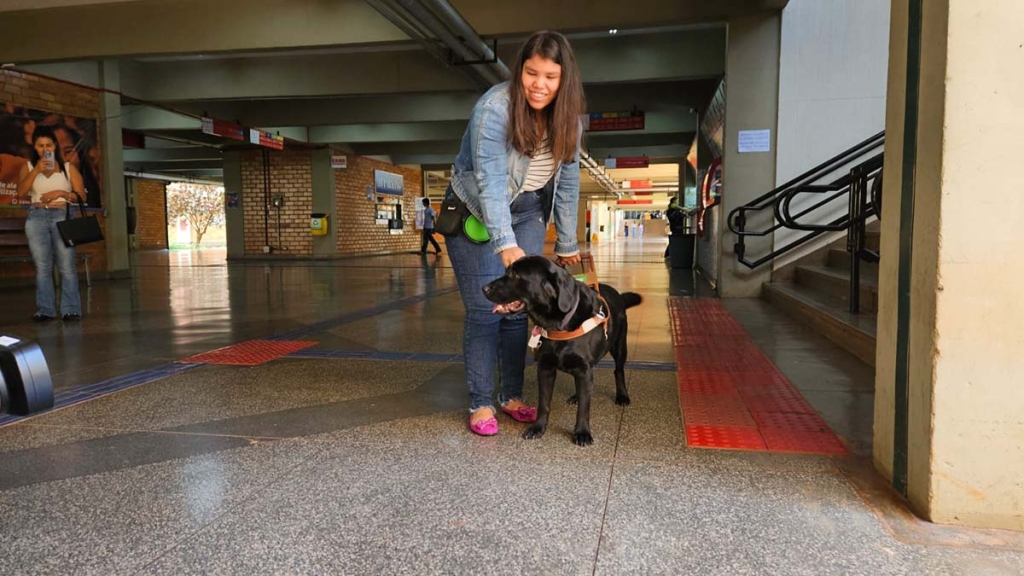
Nicole Vital, a new law student at Don Bosco Catholic University in Campo Grande, Brazil, has her faithful guide dog, Olinda, a two-year-old Labrador, with her at school. Olinda is the first guide dog to attend the university, supporting Vital throughout her law studies. Vital was born with reduced vision due to optic nerve atrophy and lost her sight completely 10 years ago.
“A guide dog is essential for my mobility,” Vital explained. “It allows me to move with greater agility. The dog is classified as a working tool, but it is also crucial for my socialization.”
Vital was selected through a free program organized by the Catarinense Federal Institute, which pairs visually impaired individuals with trained guide dogs.
Legislation guarantees visually impaired individuals the right to enter and remain in any public-access environment with their guide dog. At the Salesian university the Psycho-pedagogical Support Center assists students with special needs, providing educational support and inclusive strategies in the classroom. Vital’s classmates have welcomed Olinda’s presence and adapted well.
KENYA
Don Bosco Utume Salesian Theological College, a center for learning for those who are becoming priests in Nairobi, Kenya, has new bathrooms for its multi-use field for the community thanks to funding from Salesian Missions. The project is part of the Salesian Missions “Clean Water Initiative.”
Salesians rent out their field for use for community activities including sports, but the bathrooms were more than 25 years old. In order to be able to continue to rent out the space, which brings in revenue to help Don Bosco Utume remain self-sufficient, the block of bathrooms needed to be updated. The Karen Hospital next to the school also uses the field often, while youth use it for events.
With the funding provided, Salesians were able to build a block of bathrooms for men and women. The toilets are modern and have sensors for flushing to avoid wasting water. There are also changing rooms, lockers and showers available.
A Salesian noted, “We are grateful for the funding and what we have been able to accomplish with this project. One of the most important things for us was making sure that the men’s and women’s bathrooms had at least one toilet for a person with a disability. This project has enabled Don Bosco Utume to be part of a disability inclusion agenda.”
RWANDA
The Filippo Smaldone Institute, located in Nyamirambo, a suburb of Kigali, Rwanda, is run by the Salesian Sisters of the Sacred Heart. The institute provides primary and secondary school, as well as vocational courses to prepare students for the workforce. The institute also has special courses for students with vision and hearing disabilities, according to a recent article in Global Sisters Report.
The Salesian Sisters of the Sacred Heart congregation was founded in 1885 by St. Filippo Smaldone, who is known as the apostle of the deaf. According to the article, since 1987, the Salesian sisters have focused their work to assist those in danger of social exclusion, including students who are deaf or hard of hearing.
The institute educates more than 400 students, including 207 children with hearing loss or deafness and more than 200 without a disability. According to the article, Salesian Sister Therese Akayezu, head teacher at the Filippo Smaldone Institute, noted that by attending classes and special programs with dedicated teachers, deaf or hard of hearing children can learn skills to master a profession.
Sr. Akayezu said, “In our teaching methodology, we try to focus on improving self-esteem among children with hearing loss who sometimes develop lower self-esteem than hearing peers.”
###
Contact: [email protected]