Water projects funded by a donor through Salesian Missions are providing two villages in India access to clean water through the Clean Water Initiative. The Marathwada region in the state of Maharashtra often suffers from drought-like conditions leaving villagers without water for cooking, drinking and proper sanitation. The newly funded projects will help to desilt wells and canals, repair or replace new water piping, and install new water tanks.
In the village of Kolhewadi in the Ahmednagar district, funding helped pay for digging a new bore well, 20 feet of casing pipe, and the installation of a submersible pump of one and a half HP for the bore well, which includes HDPE pipes, panel boards and a service cable up to the connection point. The project also entailed the installation of a new water tank that holds 5,000 liters of water, and new fencing and plumbing for the water tanks.
In Pimpalgaon Ghat in the Beed district, the project entailed 1,500 meters of new pipe lines as well as fixing current piping, and the installation of a submersible pump of one and a half HP for the bore well, which includes HDPE pipes, panel boards and a service cable up to the connection point. This project also funded a new drinking water tank for the residents of the village.
In addition, Don Bosco Center Rangajan, located in Assam, will be able to construct several restroom facilities providing 50 new toilets and a septic tank, thanks to funding from Salesian Missions donors. Salesian Missions “Clean Water Initiative” will ensure that those who use the center, mostly poor, indigenous residents from a number of remote villages, will have adequate facilities to use.
At the Don Bosco Center Rangajan Salesian missionaries provide both a high school and a vocational technical training facility. Constructing decent restroom facilities will help improve health and hygiene, and curb the outbreak of diseases.
Another water project is ensuring boys attending the Don Bosco Rehabilitation Center for Street Children at Ramanthapur in Hyderabad, the capital city of southern India’s Telangana state, have improved bathroom facilities thanks to funding from Salesian Missions. The funding, provided through the Salesian Missions “Clean Water Initiative,” was used for a major renovation of the bathroom facilities at the center. Repairs were made, 10 urinals reconstructed and pipes cleaned.
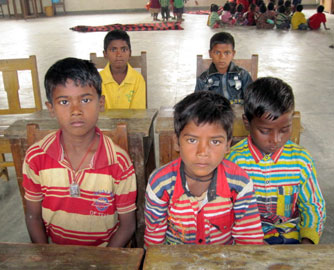
Don Bosco Navajeevan has four centers in the twin cities of Hyderabad and Secunderabad where more than 300 children, both boys and girls, are living and gaining an education. The Don Bosco Rehabilitation Center has 150 boys at the facility which provides accommodation, food, medical care and education free of cost. The boys, ages 6 to 16, are all at-risk youth who were street children, child laborers and orphans.
Girls living in a hostel at the Don Bosco Junior College in the town of Diphu, the largest administrative headquarters of the Karbi Anglong district in the state of Assam, also have access to clean water thanks to a new water project funded by the Salesian Missions “Clean Water Initiative.” In Diphu, piped water is available to only a very few residences.
The Don Bosco Junior College campus, which is 10 kilometers from the town, had been struggling to provide adequate water for washing, drinking, cooking and laundry. Reliance on hired water tankers was proving to be expensive. With funding, Salesian missionaries have been able to drill a successful borewell and offer piped water throughout the building. Piped drinking water is now available from a water purifier as well.
St. John Paul II School in the community of Maram Khullen, located in Manipur, has a new toilet complex thanks to donor funding from Salesian Missions. The project is part of the Salesian Missions “Clean Water Initiative.” The school provides education to 170 students, ages 4-13, with the support of 10 staff members. The funding was utilized for construction of the entire toilet complex from the foundation to the ceiling and walls. Funding was also used to tile the floor, paint the entire building, and install the toilets and partition them. Separate areas of the building were provided for both boys and girls.